Advisory. Projects. Retainers. Managed services. IP.
Firms may sell specialist advice, deliver defined outcomes, hold long-term retainers, manage ongoing capabilities or commercialise knowledge through frameworks, training, software and licensing.
Thinking / Industry Blueprint
Professional services businesses create value by helping clients make better decisions, solve complex problems and achieve better outcomes.
They do not produce physical goods, sell products or move inventory. Their primary asset is trusted expertise, and success depends on earning, maintaining and compounding trust.
Firms may sell specialist advice, deliver defined outcomes, hold long-term retainers, manage ongoing capabilities or commercialise knowledge through frameworks, training, software and licensing.
Growth is driven by client trust, repeat engagements, intellectual property, cross-selling, strategic partnerships and the confidence clients place in the firm.
Professional services do not hold inventory in the usual sense. Their inventory is time, capability, relationships and intellectual capital.
Specialist advice helps executives and organisations make better decisions. Value is created through expertise, clarity and confidence.
ExpertiseSpecialist expertise is applied to deliver a defined outcome. Commercial performance depends on delivery excellence and client satisfaction.
DeliveryClients engage the firm on an ongoing basis. Long-term relationships become the foundation of sustainable growth.
RelationshipThe firm takes responsibility for an ongoing business capability. Repeatability, consistency and service quality become critical.
RepeatabilityKnowledge is commercialised through frameworks, training, software, assessments, licensing, AI or digital products, allowing the firm to scale beyond individual consultants.
LeverageConsultant utilisation, delivery efficiency, pricing discipline, knowledge reuse, standardised delivery, AI augmentation, team leverage and client mix all shape margin.
Executive attention usually sits on workforce utilisation, pipeline health, resource planning, knowledge management, recruitment, staff capability and client demand.
Professional services firms often seek to increase recurring revenue, strengthen client relationships, improve profitability, reduce founder dependency, build IP, improve consistency, increase lifetime value, expand partnerships and develop future leaders.
Hiring more consultants without improving delivery systems increases complexity. Winning more work without improving capacity reduces quality. Strong personal brands without organisational capability increase founder dependency.
Growth depends on a few experts. Clients buy individuals rather than the firm. Knowledge lives in people's heads. Delivery quality varies. Pipeline visibility is inconsistent. Capacity constrains growth. Relationships remain too personal to scale.
Pipeline coverage, proposal conversion, client satisfaction, referral rate, relationship strength, workforce utilisation, employee capability, knowledge reuse and recurring revenue ratio show movement early. Revenue, gross margin, EBITDA, retention, lifetime value, profit per consultant, employee retention and IP revenue confirm the result later.
Capabilities
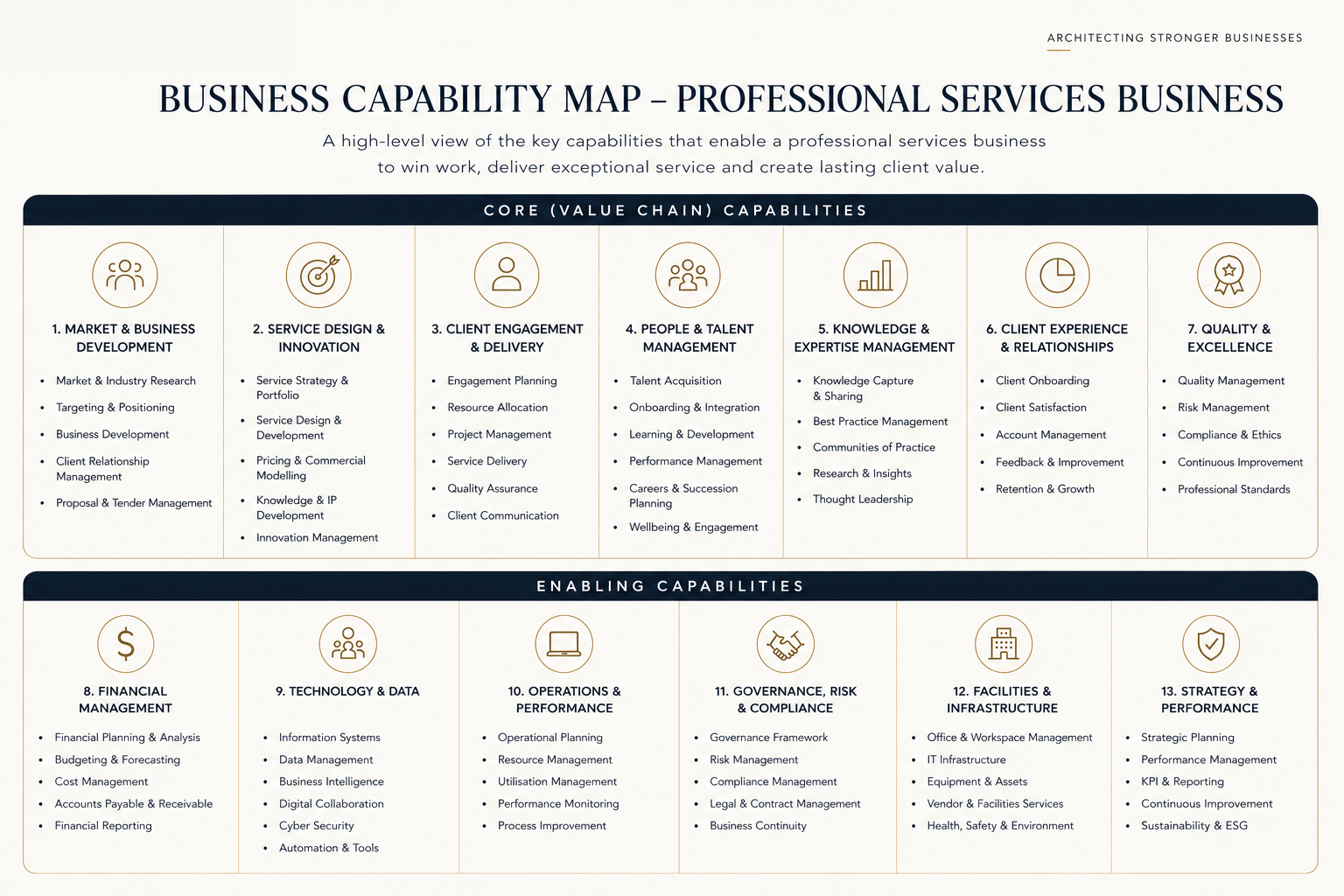
High-performing professional services firms usually strengthen business development, relationship management, client success, knowledge management, service design, proposal management, delivery management, commercial management, workforce planning, marketing, financial management and enterprise performance.
Professional services organisations typically integrate executive leadership, business development, client success, service delivery, operations, marketing, finance, people and capability, and enterprise performance.
The strongest firms deliberately transform personal expertise into organisational capability so every client receives a consistent experience regardless of who delivers the work.
Recommended techniques
Executive Playback creates a shared understanding of the firm's strategic position, client relationships and growth opportunities before significant investment or transformation.
Strategy to Outcome and align strategic priorities with measurable outcomes so investment decisions strengthen long-term enterprise capability.
Capability Mapping identifies the organisational capabilities required to scale expertise, improve consistency and reduce dependence on key individuals.
Service Architecture defines how expertise becomes a repeatable client experience. Decision Governance, Enterprise Intelligence and Control Tracking help leaders see pipeline, relationships, capacity, delivery performance and commercial outcomes together.
Professional services firms are learning how to scale value without making the client experience feel standardised in the wrong way.
The firms that lead will turn trusted relationships into long-term partnerships and knowledge into scalable enterprise assets.
The opportunity is not only faster work. It is better transfer of method, context and insight across the firm.
In professional services, strategy becomes real when trusted expertise becomes a capability the whole firm can carry.
Continue to Service Architecture