Assets only create value when they are used well.
Production capacity, asset utilisation, workforce capability and equipment reliability determine how much value the business can create from the assets it already owns.
Thinking / Industry Blueprint
Manufacturing businesses create value by transforming raw materials and components into products through the disciplined use of people, equipment, technology and production systems.
Factories, production lines, machinery and equipment are not just operating infrastructure. They are significant investments that have to generate commercial return.
The manufacturers that outperform do not simply produce more. They maximise the value generated by every asset across the enterprise.
Production capacity, asset utilisation, workforce capability and equipment reliability determine how much value the business can create from the assets it already owns.
Customer demand, product mix, quality expectations, supply chain performance and commercial priorities shape what should be made, when and why.
Plant utilisation, raw material inventory, work in progress, finished goods, maintenance investment and cashflow all influence whether manufacturing capability becomes commercial value.
Individual products are assembled from multiple components. Performance depends on production planning, engineering excellence and quality control.
AssemblyProducts are produced through continuous or batch production. Advantage comes from process stability, yield and consistency.
StabilityProducts are manufactured based on forecast demand. Success depends on forecast accuracy, production planning and inventory optimisation.
ForecastProduction begins when customer orders are confirmed. Capacity management, lead times and operational flexibility become critical.
FlexibilityProducts are designed before manufacture. Commercial performance depends on engineering capability, project execution and disciplined governance.
GovernanceProducts are manufactured for other organisations. Quality, capacity, cost efficiency, reliability and long-term relationships create advantage.
ReliabilityProduction capacity, product innovation, market demand, quality, customer retention, export growth and operational scalability all influence revenue.
OEE, labour productivity, material yield, waste reduction, product mix, procurement, energy efficiency, automation and asset utilisation determine margin performance.
Return on assets, return on invested capital, working capital, inventory turns, maintenance investment and equipment reliability show whether the asset base is creating commercial value.
Commercial economics
The objective is to maximise commercial value generated from manufacturing capability.
Manufacturing leaders continuously balance capacity, demand, quality, cost, asset utilisation, working capital, capital investment and operational resilience.
Producing more can reduce performance if it creates excess inventory. Cutting maintenance can improve short-term profit while increasing long-term operational risk. Investing in new machinery can reduce return on capital if demand, workforce capability and downstream constraints have not been understood.
Common objectives include improving asset utilisation, increasing OEE, improving throughput, reducing manufacturing costs, improving quality, reducing waste, optimising working capital, increasing flexibility, strengthening supply resilience and lifting return on invested capital.
Under-used assets, capacity constraints, unplanned downtime, quality failures, rising production costs, material shortages, excess inventory, poor visibility, ageing equipment and silos between engineering, production, supply chain and finance are rarely isolated issues.
OEE, capacity utilisation, first pass yield, schedule adherence, scrap rate, downtime, supplier performance, maintenance compliance and inventory accuracy show whether manufacturing performance is moving in the right direction.
Revenue, gross margin, cost per unit, return on assets, return on invested capital, working capital, inventory turns, warranty claims and EBITDA confirm whether operational improvement has become business performance.
Capability architecture
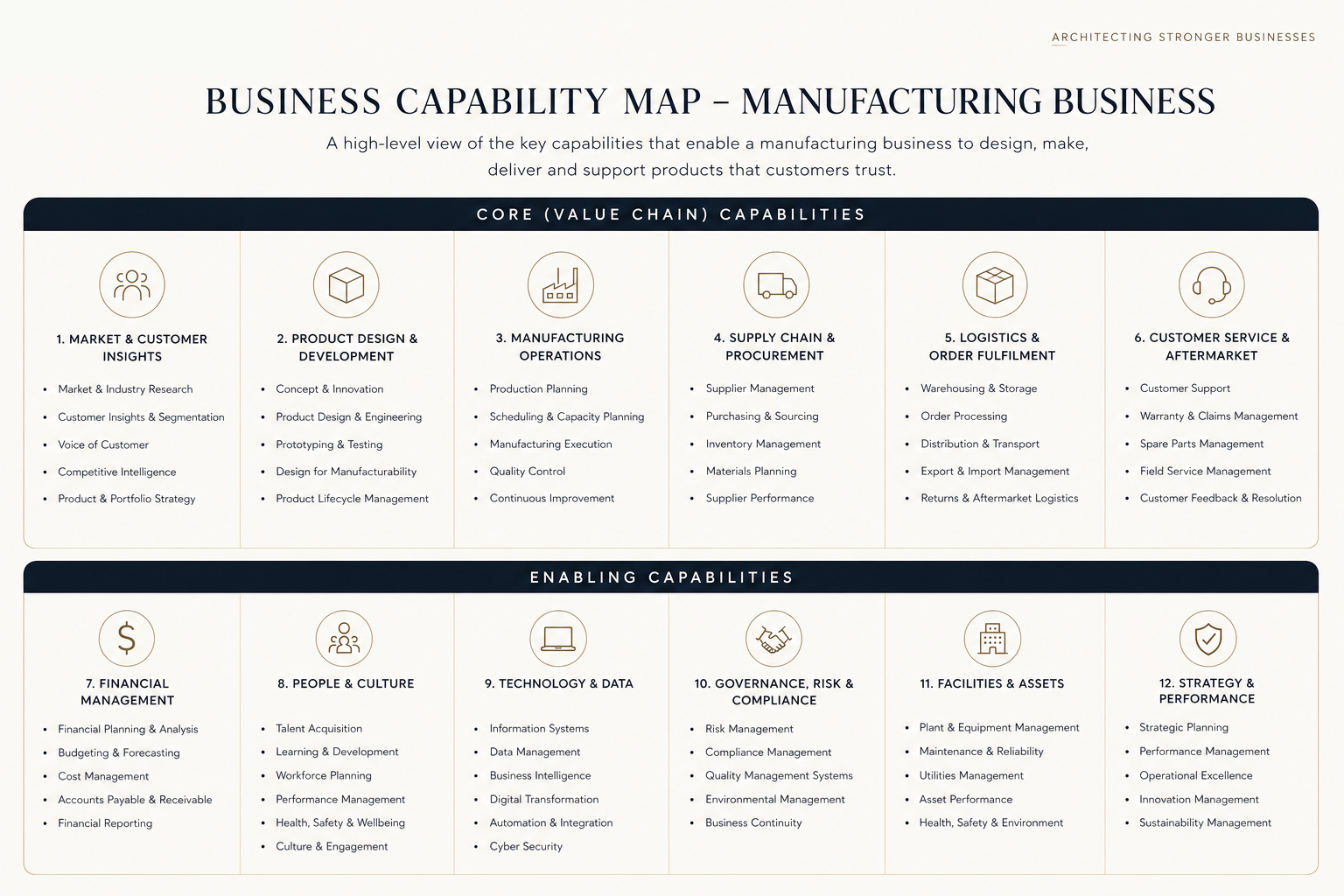
High-performing manufacturing organisations strengthen product development, engineering, production planning, manufacturing operations, maintenance and asset management, quality management, procurement, supply chain, logistics, commercial finance, enterprise performance and digital manufacturing.
The operating model usually brings together executive leadership, sales, product management, engineering, manufacturing, maintenance, supply chain, procurement, logistics, finance, digital technology and enterprise performance.
Competitive advantage comes from aligning those functions around enterprise outcomes rather than letting each optimise its own performance in isolation.
Strategy to Outcome
They struggle when investment decisions, production planning and commercial priorities become disconnected.
Strategy to Outcome helps manufacturing leaders align commercial strategy, capital investment, operational capability and enterprise governance so manufacturing assets consistently create long-term business value.
It brings the conversation back to one question: how does this asset base create value, and what decisions are required for that value to keep compounding?
Recommended techniques
Executive Playback creates a shared executive understanding of manufacturing performance, strategic priorities and investment opportunities before significant change.
aligns strategic objectives with measurable manufacturing and commercial outcomes.
Capability Mapping identifies the capabilities required to maximise production performance, quality, innovation and asset returns.
Decision Governance clarifies how strategic, engineering, operational and investment decisions are made across the organisation.
Enterprise Intelligence and Control Tracking connect operational, financial, engineering and commercial indicators into one decision-making view.
Better signals create value only when the organisation can make disciplined decisions from them.
The technology matters, but the advantage comes from governing it through capability, investment and operational reality.
The manufacturers that lead will convert operational improvement into durable commercial performance.
In manufacturing, strategy becomes real when assets, capability and commercial decisions are governed as one system.
Continue to Capability Mapping