Primary care. Hospitals. Allied health. Aged care.
Also pathology, diagnostic imaging and healthcare technology, each with different revenue mechanics and operating constraints.
Thinking / Industry Blueprint
Healthcare organisations exist to improve human health, but they operate through different commercial models, funding mechanisms and regulatory environments.
Success cannot be measured by financial performance alone. Leaders have to hold patient outcomes, clinical quality, safety, workforce capability, compliance and sustainability together.
Also pathology, diagnostic imaging and healthcare technology, each with different revenue mechanics and operating constraints.
Revenue may come through Medicare, private billing, activity-based funding, insurers, resident contributions, contracts, subscriptions or licensing.
Patient volumes, referrals, occupancy, service mix, specialist capability and long-term relationships shape revenue, margin and cashflow.
Commercial success depends on patient access, continuity of care, appointment design, workforce utilisation and retention.
AccessLeaders have to balance capacity, clinical outcomes, safety, length of stay, workforce availability and funding realities.
CapacityThe commercial challenge is balancing clinician utilisation with quality of care, referral confidence and service consistency.
UtilisationPerformance depends on occupancy, care quality, workforce capability, compliance and resident experience.
TrustReferral volumes, turnaround time, equipment utilisation and clinical reliability become significant competitive advantages.
FlowRevenue may come from software, licensing, implementation or managed services, but commercial success depends on adoption.
AdoptionHealthcare strategies often focus on access, waiting times, workforce productivity, clinician utilisation, digital capability, administrative burden, continuity of care and patient satisfaction.
Healthcare organisations rarely fail because they lack strategy. They struggle when strategy becomes disconnected from clinical operations, workforce capability, funding realities and quality obligations.
Workforce shortages, growing demand, capacity constraints, long waiting lists, funding pressure, fragmented technology, compliance complexity, administrative burden and limited executive visibility are rarely isolated issues.
Appointment availability, clinician utilisation, waiting times, referral volumes, theatre utilisation, staff turnover, compliance observations and digital adoption are early signals. Patient outcomes, satisfaction, margin, cost per patient, readmissions, incidents and retention confirm the pattern later.
Capabilities
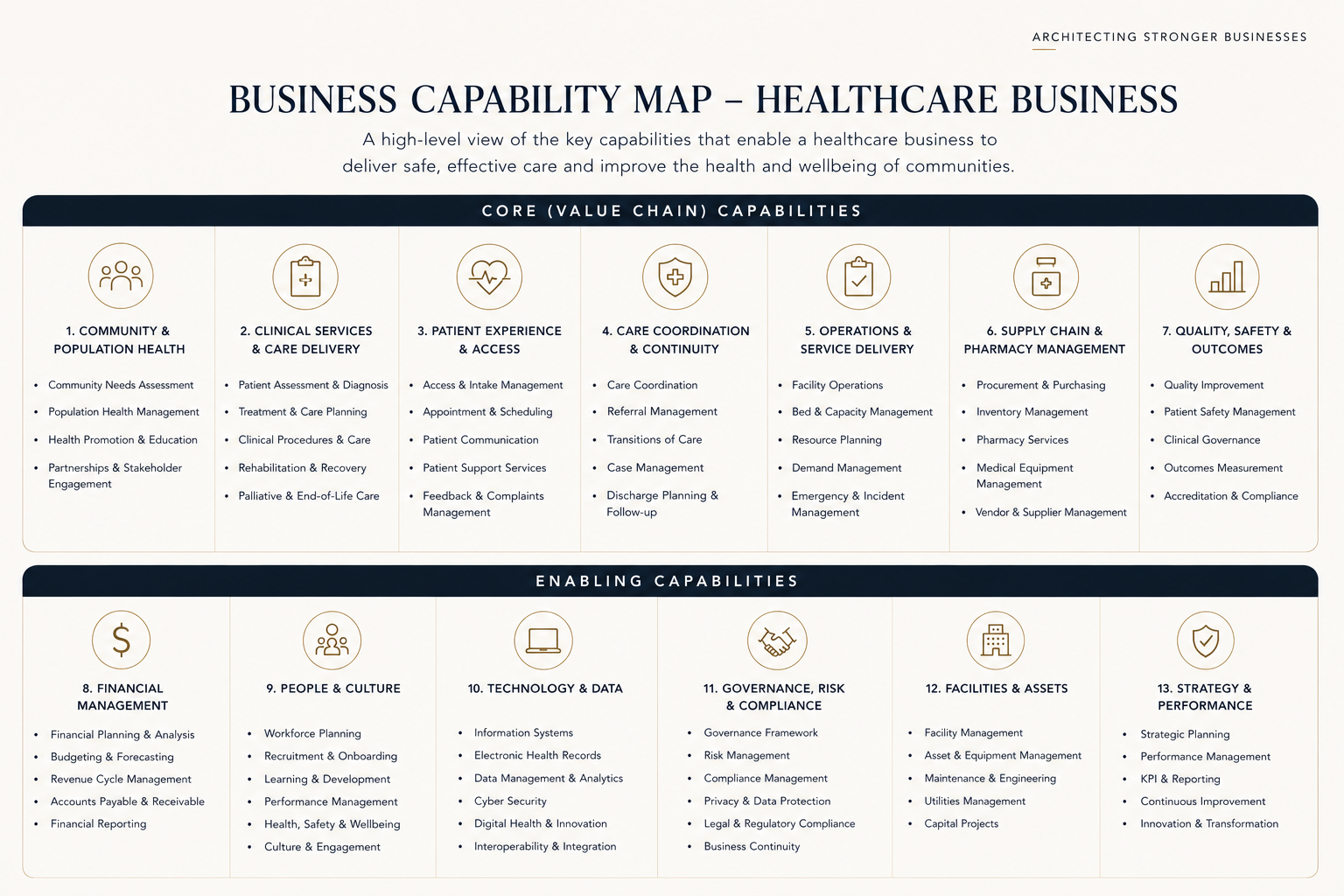
High-performing healthcare organisations usually strengthen clinical governance, patient services, workforce planning, scheduling, revenue cycle management, digital health, procurement, risk management, quality management, compliance, finance, information management and community engagement.
Most operate through interconnected clinical, operational and corporate services. The challenge is ensuring every function contributes to both patient outcomes and organisational sustainability.
Recommended techniques
Strategy to Outcome helps connect strategic objectives with the capabilities, governance and operating rhythms required to improve both patient outcomes and organisational performance.
Capability Mapping identifies the capabilities that most influence patient outcomes, workforce performance and operational sustainability.
Decision Governance clarifies clinical, operational and executive decision rights while respecting regulatory and professional responsibilities.
Enterprise Intelligence and Control Tracking connect demand, capacity, workforce, quality, safety and financial performance into a shared executive view. helps leadership align on outcomes and investment decisions before the work fragments.
Healthcare organisations need to connect patient outcomes, funding realities, workforce capacity and operational sustainability in one view.
Digital health only improves outcomes when the operating model, clinical governance and workforce can absorb the change.
The opportunity is real, but it depends on governance, data quality and clear clinical accountability.
In healthcare, strategy becomes real when clinical, operational and commercial decisions improve outcomes together.
Continue to Enterprise Intelligence