Government services. Grants. Membership. Charities. Social enterprise.
The delivery model changes, but the discipline remains the same: converting mission, policy or purpose into accountable outcomes.
Thinking / Industry Blueprint
Government agencies and not-for-profit organisations exist to create public, community or social value.
Unlike commercial organisations, success is not measured primarily by profit. The challenge is to deliver meaningful outcomes while maintaining accountability, transparency and financial responsibility.
The delivery model changes, but the discipline remains the same: converting mission, policy or purpose into accountable outcomes.
Value is created through better community outcomes, improved service access, effective policy implementation, education, advocacy, social impact and public trust.
Leaders still have to balance funding, workforce, compliance, risk, capacity and long-term sustainability.
Services funded through taxation or public investment must achieve policy outcomes while managing finite public resources.
Public serviceFunding is secured through government grants, philanthropic organisations or research programs. Success depends on impact, compliance and sustainable delivery.
FundingIndustry associations, professional bodies and sporting organisations rely on delivering ongoing value to members.
MembersFunding may come from donations, grants, fundraising, partnerships or social enterprise activity. Mission impact and sustainability have to move together.
CommunityCommercial activity generates revenue that supports a social or environmental purpose. Financial viability and community outcomes must be managed together.
PurposePerformance depends on service quality, community engagement, workforce capability, funding effectiveness, program outcomes, collaboration, operational efficiency and governance maturity.
Financial sustainability is influenced by funding certainty, grant success, budget management, resource allocation, workforce utilisation, asset management and partnership effectiveness.
Strategies often focus on community outcomes, service accessibility, public trust, operational efficiency, measurable impact, workforce capability, governance, financial sustainability, stakeholder engagement and collaboration.
These organisations rarely struggle because they lack purpose. They struggle when strategic priorities, funding decisions and operational delivery become disconnected.
Access may improve, but quality can fall if capability, workforce and funding do not increase with demand.
Trade-offCapacity may increase, but delivery teams can become overwhelmed if resources and governance are not aligned.
Trade-offRisk may reduce, but innovation and community impact can suffer if governance becomes the work instead of supporting it.
Trade-offTransparency may improve, but reporting burden can pull attention away from service delivery if the operating model is not designed well.
Trade-offGrowing demand, limited funding, workforce shortages, compliance pressure, difficulty measuring impact, siloed delivery, funding uncertainty, legacy technology, fragmented decisions and competing community needs often appear together.
Service accessibility, program participation, employee engagement, community satisfaction, stakeholder engagement, budget utilisation, project delivery, compliance performance and partnership effectiveness show movement early. Community outcomes, service outcomes, strategic achievement, financial sustainability, public trust, grant success, audit outcomes and workforce retention confirm the result later.
Capabilities
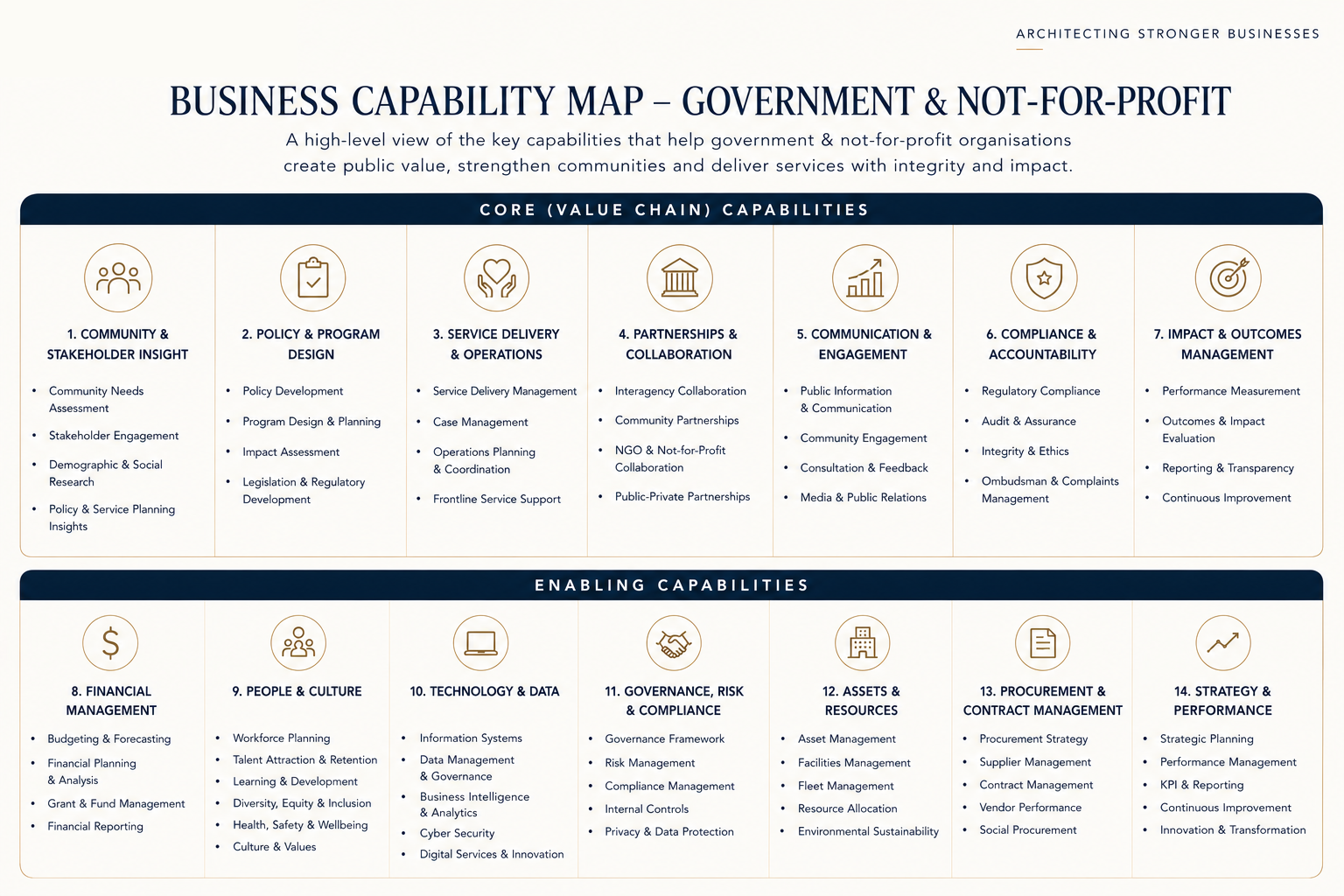
High-performing government and not-for-profit organisations usually strengthen policy and strategy, service design, community engagement, program delivery, funding management, financial management, workforce planning, risk and compliance, governance, performance management, digital services and enterprise performance.
These organisations typically integrate executive leadership, strategy and policy, program delivery, community services, finance, people and capability, risk and governance, digital technology and enterprise performance.
Success depends on aligning policy intent, operational execution and measurable community outcomes.
Recommended techniques
Executive Playback builds a shared understanding of organisational priorities, community needs and operational challenges before significant change or investment.
Strategy to Outcome and help connect strategic objectives with measurable organisational and community outcomes, so investment decisions support long-term mission success.
Capability Mapping identifies the capabilities required to improve service delivery, governance and sustainable impact.
Decision Governance clarifies strategic, funding and operational decisions, improving accountability and transparency. Enterprise Intelligence and Control Tracking bring service performance, program delivery, funding, workforce capability and strategic priorities into one view.
Government and not-for-profit leaders need to show how resources become measurable value for the communities they serve.
The organisations that lead will combine strong governance, capable people and clear accountability across partners, programs and funding models.
Technology can extend capacity, but only when evidence, governance, accountability and human responsibility remain clear.
In government and not-for-profit work, strategy becomes real when purpose, resources, governance and public value can be understood together.
Continue to Decision Governance