The industry can change. The ownership model is the difference.
Family businesses operate across professional services, construction, manufacturing, agriculture, retail, wholesale, hospitality, property, healthcare and more.
Thinking / Industry Blueprint
Family businesses are governed by relationships as much as commercial performance.
Every decision affects customers, employees and shareholders, but also parents, children, siblings and future generations. Strategy extends beyond business performance into family stewardship.
Family businesses operate across professional services, construction, manufacturing, agriculture, retail, wholesale, hospitality, property, healthcare and more.
Wealth is often created through operating income, asset growth, intergenerational ownership, relationship capital and capital preservation.
Profitability, cashflow, lifestyle, succession, tax efficiency, reputation, family employment and resilience often have to be balanced together.
The trading business needs to keep performing while the family considers longer-term ownership and succession decisions.
IncomeProperty, equipment, intellectual property and long-term investments often become part of the family's commercial architecture.
AssetsCustomers, suppliers, employees and community reputation can become advantages that are difficult for competitors to copy.
TrustMany family businesses protect accumulated wealth rather than maximising short-term returns.
ResilienceThe business has to create options for the next generation, even when the next generation may want something different.
SuccessionCommercial decisions can be rejected when they threaten relationships, identity or future ownership.
StewardshipFamily businesses often need to professionalise operations, reduce founder dependence, improve governance, diversify income, prepare the next generation, strengthen management capability and create succession options.
Family businesses rarely struggle because they lack ambition. They struggle when intuitive decision making, informal roles and founder-held knowledge become difficult to sustain.
Everything depends on the founder. Decisions remain centralised. Family and business roles blur. Successor capability is unclear. Growth outpaces systems. Conflict influences commercial decisions.
Decision concentration, founder dependency, management capability, successor readiness, family engagement, cashflow stability, governance maturity and leadership development are early signals. Profitability, valuation, return on capital, retention and succession outcomes confirm the pattern later.
Capabilities
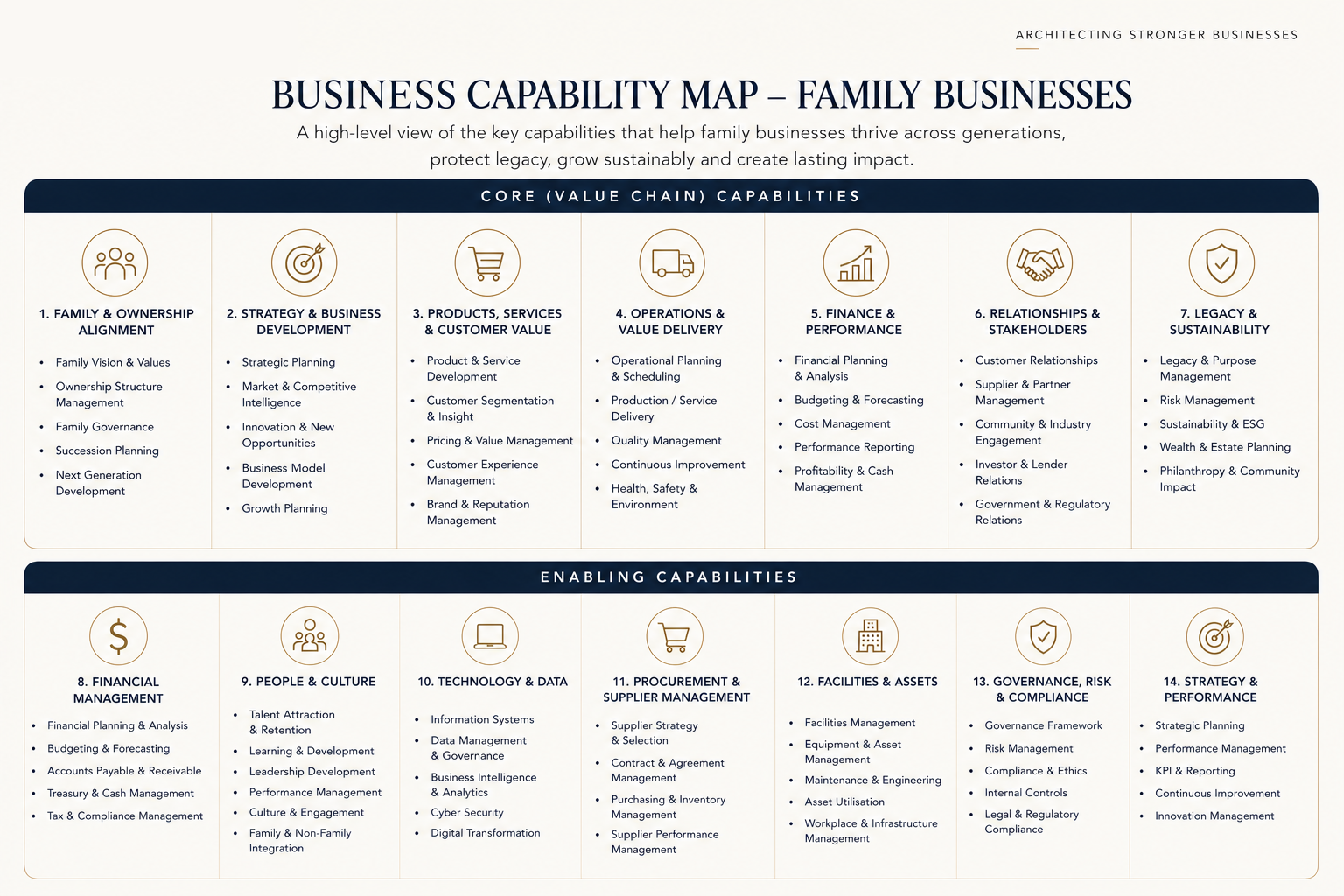
High-performing family businesses intentionally strengthen strategic planning, governance, leadership development, succession planning, financial management, wealth management, decision governance, risk management, relationship management, workforce capability, knowledge management and business improvement.
As the organisation grows, these capabilities reduce dependence on the founder and make the business easier to govern, improve and eventually transfer.
The founder makes most significant decisions. Knowledge is held by individuals and relationships drive the business.
OriginFamily members begin sharing operational responsibility. Decision making becomes more distributed, but often remains informal.
ParticipationIndependent executives and specialists are introduced. Formal governance begins to emerge.
StructureThe business can operate beyond individual family members. The family governs ownership, purpose and long-term direction.
ContinuityRecommended techniques
Executive Playback creates a shared understanding of the current business before significant change is undertaken. This is useful where family members hold different versions of the business in their heads.
Strategy to Outcome and help connect family priorities, business outcomes and investment decisions without collapsing every conversation into day-to-day operations.
Capability Mapping identifies the capabilities required to reduce founder dependency and support sustainable growth. Decision Governance clarifies which decisions belong to owners, directors, executives and operational leaders.
Enterprise Intelligence and Control Tracking give the family and management team a shared view of strategic performance, operational execution and business health.
Families are planning ownership and leadership earlier because the cost of delay is harder to absorb when the business, assets and stakeholders have grown.
The best family businesses separate ownership governance from operational management without losing the identity that made the business valuable.
The question is not only which tools to use. It is which capabilities, standards and decision rights need to exist before the business scales them.
In family businesses, strategy becomes real when legacy, governance and commercial performance can move together.
Continue to Decision Governance