Fixed price. Cost plus. Schedule of rates.
Also design and construct, construction management and asset maintenance contracts.
Thinking / Industry Blueprint
Construction and infrastructure businesses do not manufacture products or deliver repeatable services in the traditional sense. They generate value by successfully delivering projects and assets.
Every project is effectively its own business, with its own commercial model, budget, resources, schedule, risks, customers, suppliers and outcomes.
Also design and construct, construction management and asset maintenance contracts.
Estimating, productivity, equipment utilisation, procurement, subcontractor performance, claims and rework all shape margin.
Progress claims, payment timing, retentions, work in progress, debtor management and supplier terms are central to survival.
Revenue is agreed before work begins. Profit depends on estimating accurately, controlling scope and delivering efficiently.
RiskThe customer pays actual costs plus margin or fee. Success depends on transparency, commercial governance, cost control and trust.
TrustRevenue is generated from agreed rates for completed work. Productivity and resource allocation become critical.
ProductivityThe contractor carries design and construction together, making engineering, procurement, delivery and decision governance inseparable.
IntegrationThe builder manages subcontractors and delivery on behalf of the client. Relationship management becomes a critical capability.
RelationshipsRecurring contracts for roads, rail, defence, utilities, hospitals or councils can create more stable cashflow than project work.
RecurringConstruction and infrastructure strategies often focus on project profitability, tender win rate, rework, labour productivity, repeat clients, subcontractor performance, forecasting accuracy, safety, equipment utilisation and working capital.
Increasing revenue without sufficient delivery capability often damages profitability. Pipeline, capacity, margin, cash and risk have to be managed together.
Poor project visibility, inconsistent estimating, margin leakage, cost overruns, cashflow pressure, programme delays, resource conflicts and reactive decision making often point to inconsistent enterprise capabilities.
Tender pipeline quality, bid conversion, labour utilisation, forecast accuracy, safety observations, procurement lead times, programme variance, variation approvals and equipment utilisation are leading signals.
Capabilities
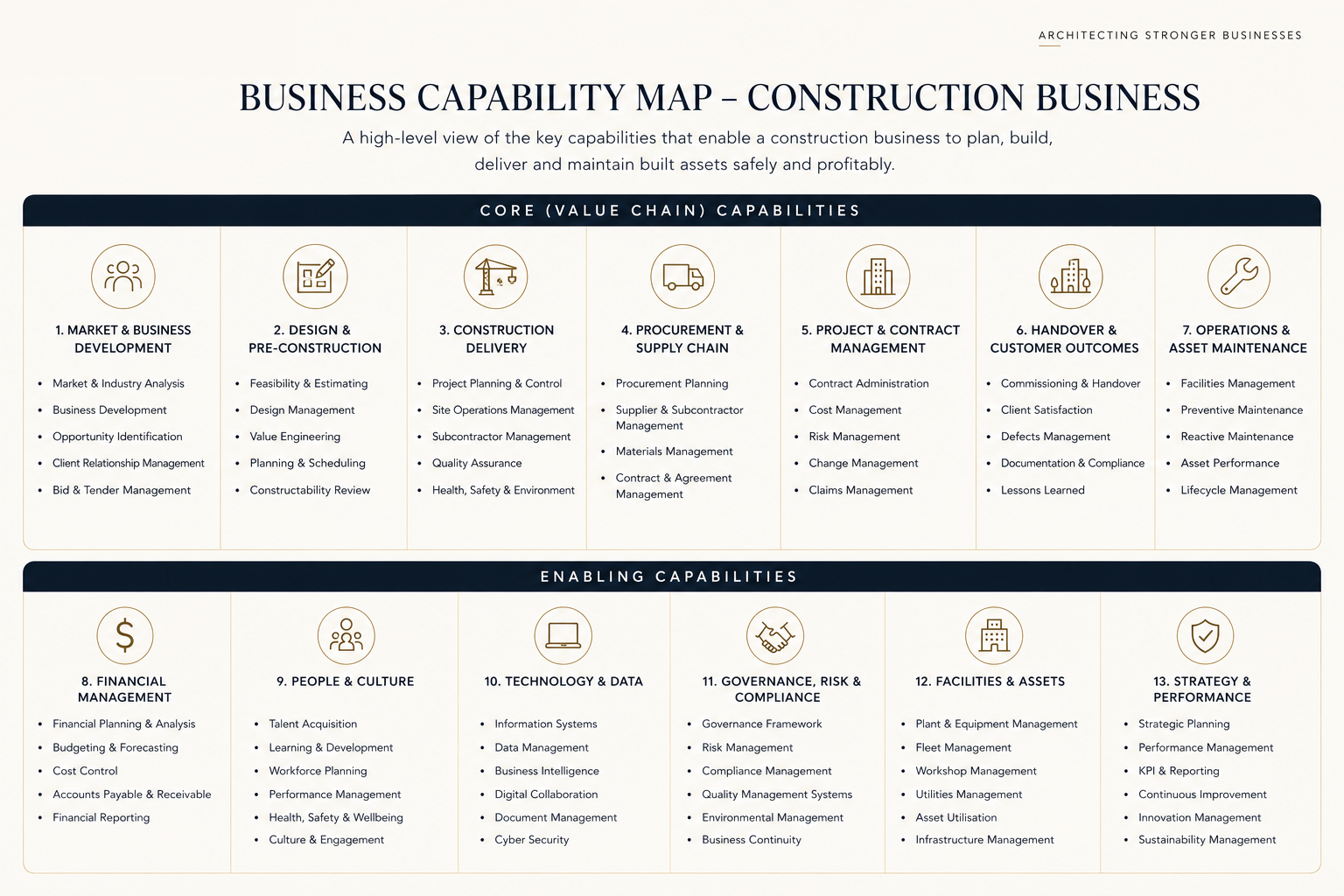
High-performing construction businesses usually invest in business development, estimating, commercial management, project controls, procurement, contract administration, resource planning, financial management, risk management, health and safety, asset management, workforce planning and client relationship management.
Most operate through a matrix of executive leadership, commercial, operations, project delivery and shared services. The challenge is maintaining governance while allowing individual projects enough flexibility to respond to changing site conditions.
Recommended techniques
Construction and infrastructure strategy often starts with Strategy to Outcome because leaders need to connect enterprise ambition with day-to-day project delivery.
Capability Mapping identifies the capabilities that differentiate successful project delivery and where investment will create the greatest commercial value.
Decision Governance reduces inconsistency across projects by defining who makes which decisions, when and with what information. Enterprise Intelligence gives leaders earlier signals across commercial, operational and delivery risk.
Control Tracking create a shared executive view of pipeline, projects, commercial performance and strategic priorities. helps clarify direction, business outcomes and operating priorities before major investment.
Construction leaders need to understand risk, margin, capacity and cash before external pressure turns into project failure.
The advantage is not the technology alone. It is the operating discipline to convert better coordination into safer, more profitable delivery.
Better signals only create value when the organisation has the data, authority and decision discipline to act on them.
In construction and infrastructure, strategy becomes real when every project can act with enough freedom to deliver and enough governance to stay aligned.
Continue to Commercial Architecture